
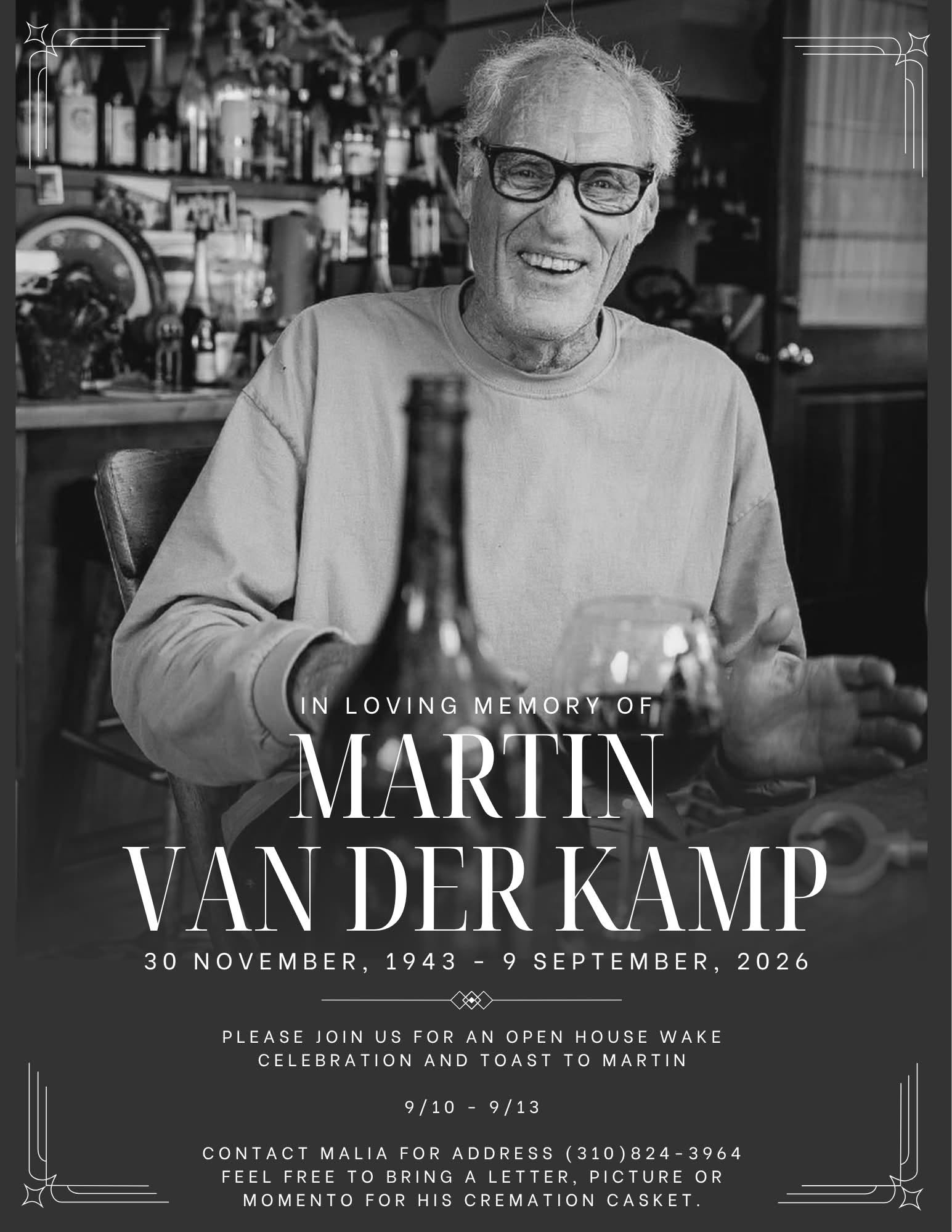
I started buying grapes from Martin Van der Kamp back in 1996. Here was an old Pinot Noir vineyard – dating back to the 1950s and a time when quality American Pinot Noir was something akin to the Fountain of Youth sought by Ponce de Leon. Located near the top of Sonoma Mountain Road, this wasn’t an area that was even in the conversation of great Pinot Noir. At the time Carneros and Russian River dominated the stage for Northern California and Santa Barbara County in the south.
But once you visited Van der Kamp, there was no denying that there was something special about this place. The Pomos held a myth that cited Sonoma Mountain as the place where humankind was created. The vineyard itself backs to the mountain, with a fresh stream and pond near the top of the planted property. This unique location made this an ideal spot for various native American tribes to meet and trade goods. To this day, you can find Native American artifacts on the property.
I am not certain if Martin and Dixie Van der Kamp found this place, or if it found them, but one cannot imagine better stewards of this land. There were fruit trees, vegetable gardens, giant pumpkins, a weed shack, roosters crowing constantly, artifacts and antiques, Hawaiian symbols (Martin and Dixie have a home in Molokai – they let me stay there), a friendly dog or two, an underground wine cellar, children and eventually grandchildren roaming the property, and oftentimes colorful visitors from distance land staying there in Martin & Dixie’s house – each one of them with a unique story. And these were simply the things that one encountered within five minutes of visiting the property. If it sounds something like what we used to call a hippie commune, you wouldn’t be wrong – but that’s far too simplistic.
First off, Martin was a capitalist. He and Dixie had created a sparkling wine brand – Van der Kamp Sparkling Wines. Martin had visited with some of the finest Champagne producers in the world. He had talked to them about their processes. Because of who he was, they had shared things with him that weren’t generally public knowledge. For example, he had recipes for various dosages that he could pinpoint to specific Champagne houses. In my life, some of the finest sparkling wines I’ve had have come from their cellar (to be fair, not all were that great. Experimental learning has great successes – and some failures). You might assume that these were made in the spirit of openness that would define a commune – and bottles were always available to share – but they were also made in the spirit of capitalism. Martin loved to sell wine. He’d talk about the wine market, the finances involved in making wine, the challenges of selling it, and he’d always be open to learning more about the minute details of production costs, distribution dynamics, and more. Martin and Dixie were the first to volunteer to come to Siduri and pour the wine made form their grapes and help sell it. Wine was shared, but it was sold. Martin never forgot that.
What one discovered at Van der Kamp wasn’t a commune, it was a family. And a family in the best sense of the word. And you were invited to be part of that family.
I took my older, fairly conservative Southern Baptist mother to Van der Kamp and she fell in love with the people and the place. She went there with me several times. We spent Thanksgiving there once. At one point, a joint was being passed around among the adults, and I watched in trepidation as to how my Mom would react. Instead of reacting with condemnation or horror, she calmly took the joint and passed it on to the next adult. Mom neither drank nor smoked, but that didn’t matter. At Van der Kamp she was family. Well into her 90s, as long as my Mom had her own place, her refrigerator was covered in pictures of her grandchildren and the Van der Kamps annual Christmas card. I am not certain that my picture was up there.
One cannot mention Martin Van der Kamp without mentioning stories. Martin was a masterful storyteller. Really and truly masterful. I don’t know that he practiced it, I think it just came naturally. Even by the time I met him in 1996, he had lived enough life to fill three or four normal lifetimes. And he would share those experiences with anyone willing to listen. There were stories of people and places and shaman and myths and so much more. There were very few quick visits to Van der Kamp, because what was planned to be a quick 10 minute grape sampling trip far too easily turn into an hour long story about something that you didn’t know you were interested in until you heard it. If I have one regret, it is that I made too many of those planned 10-minutes visits into 20-minute visits rather than letting them be hour long visits.
Even after I sold Siduri – and stopped making the wine – I kept in touch with Martin and Dixie. Not as often as I should have – or wanted to – but I never felt like we lost touch. Morét and I went up there once together. I knew she had to experience Martin and Dixie, and this place. Our planned 30 minute visit lasted about 2 hours. I made it up to see Martin during the last week of his life on this earth. He was not doing well. It was more a visit with Dixie and his daughter, Malia, than it was with Martin. But even though he wasn’t there in the traditional sense of the word, the place was filled with him.
Before going to see Martin for the last time, I read up a bit on Ho’oponopono. I didn’t’ want to get see Martin unprepared. Ho’oponopono is a Hawaiian practice that takes place near the end of someone’s life in this world and is meant to bring things back into balance and make things right. Before I left Van der Kamp Vineyard that day, I turned towards the house, towards Martin, and I silently repeated the four phrases that make up Ho’oponopono. “I’m sorry.” “Please forgive me.” “Thank you.” “I love you.”
Over my life, I’ve wondered sometimes about the afterlife. There are things I was raised to believe, things I’ve doubted, things that I’ve taken by faith, and things I am pretty sure are just there to make us feel better. Martin, as much as any person I’ve experienced in this life, makes me believe that life goes on after we die. He will always been in that place on Sonoma Mountain, always be in my heart, and always make me strive to be better.