
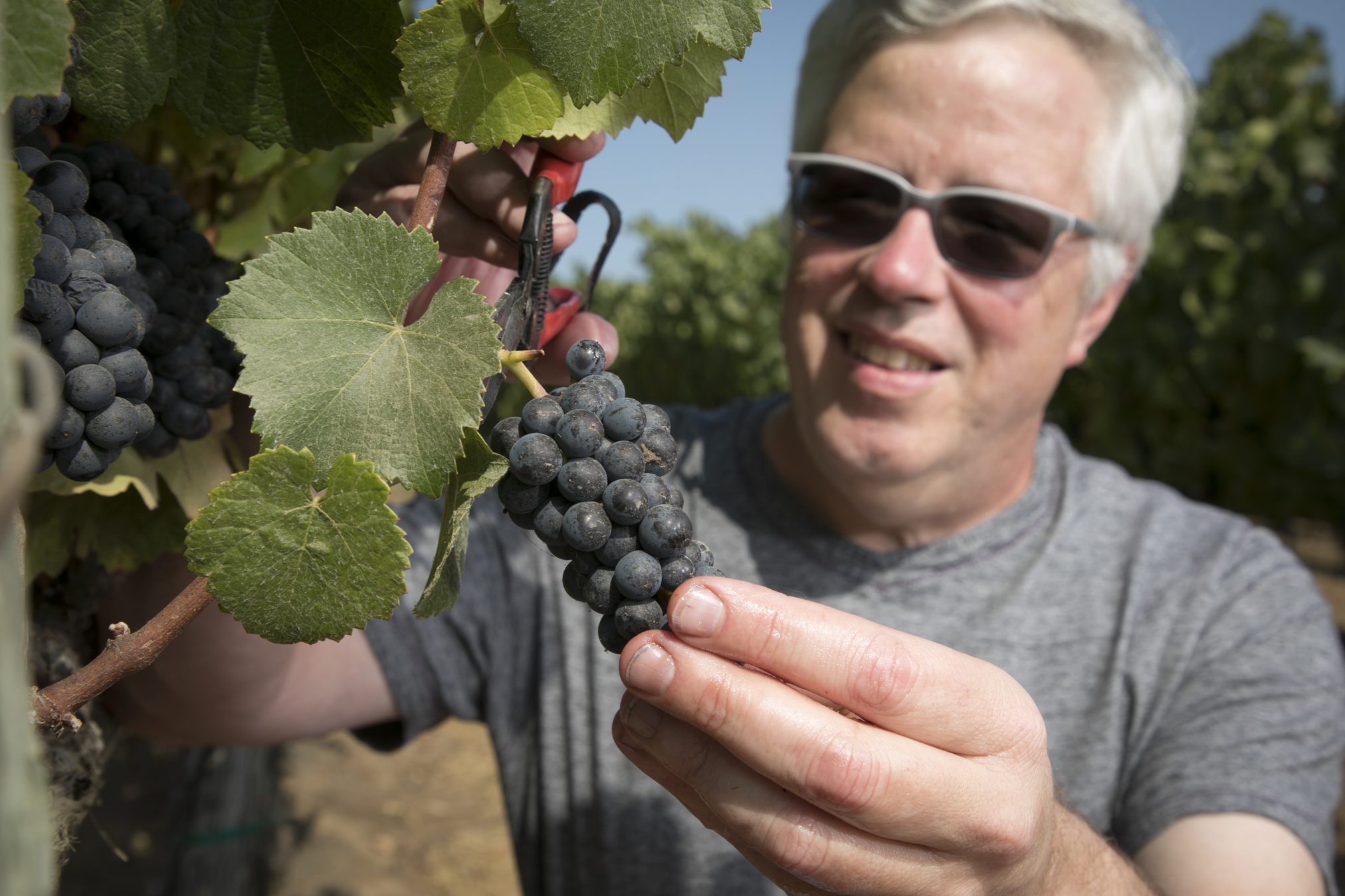
Over 33 years of making wine, I’ve learned more lessons than I could possibly list. Some came from other winemakers. Some from mistakes. And some I apparently needed to relearn—several times—before they finally stuck. But one lesson returns every harvest. And this year, it came a little harder.
The grapes don’t care.
I love the grapes. I’ve loved them through every vintage of those 33 years. But when it comes to scheduling, our relationship is decidedly one-sided.
- Your kid’s first day of school? The grapes need picking.
- Got the flu and feel like shit? That’s the perfect day to bring in fruit.
- I’ve always wanted to see the fall colors in the Northeast. The grapes haven’t approved that vacation request.
They ripen when they ripen. They need what they need. And every year, the rest of us rearrange our lives around them. This year, I had a little more rearranging to do.
In June, while we were in Spain on a Clarice Member trip, Morét and I jumped on a Zoom call and learned that I had prostate cancer again.
The grapes didn’t care.
Some of you may remember that I was diagnosed with early-stage prostate cancer in 2017. I chose a treatment called HIFU—High-Intensity Focused Ultrasound. It worked well, and the whole experience disrupted my life remarkably little.
Since I went public about my HIFU treatment, more people than I can count have approached me asking whether it might work for them—and quite a few have gone that route. At the time, the cancer was confined to one side of my prostate, so that side was treated. But looking back on the notes, there was one spot on the other side that looked concerning—though it wasn’t cancer yet. That spot wasn’t treated.
Over the last couple of years, my PSA started creeping upward. The number was still low, but the direction was enough to warrant a closer look. An MRI revealed a new tumor—exactly where that earlier concerning spot had been.
And this one was a bastard. It was aggressive, and there was concern it might extend beyond the prostate. The next step was a PET scan to look for spread. First came the nervous waiting for the scan results. Then came the prospect of waiting for an appointment to hear them.
Dr. Glamore spared us the second wait. He called to tell us there was no evidence the cancer had spread beyond my prostate.
Fantastic news. An enormous relief.
The grapes, however, remained unmoved.
With testing and biopsy came a treatment plan. I started medications—not the fun drugs—and began a series of shots to bring my testosterone down to practically zero. The goal is to take away the fuel the cancer needs to grow. That part of treatment is expected to continue for at least 18 months.
I also had tiny gold markers placed inside me to help guide radiation. Starting in mid-November, the plan is 25–30 treatments over roughly five to six weeks. Apparently, I now contain precious metals. Morét is choosing to call it an upgrade.
I’ve handled this diagnosis differently than I’ve handled other health issues. Usually, I tell people. Probably more people than necessary. Sharing comes naturally to me—and over the years, it’s brought good things: friends telling me their stories, people passing along what they’ve learned, relationships became closer because we finally talked about something that mattered.
This time, I kept the news within a small circle—friends and family, a couple of dozen people. It wasn’t easy. But I wanted a team in place in case I needed them.
And what a team it has been.
There have been offers to help with harvest, offers to help with just about anything, check-in texts, phone calls, and a few cancer jokes in sufficiently bad taste to make me laugh. You know who you are. Thank you for knowing me well enough to send them.
And then there’s Morét.
I doubt this was what she had in mind when she married me last year, but she’s been beside me through the appointments, the waiting, the decisions, and everything else that happens when you’re trying to absorb that you have cancer. I’m usually pretty good with words. I don’t have enough of them for what that has meant.
Still, I waited until now to share this more widely.
Part of the reason was the grapes. I knew they weren’t going to care. And somewhere along the way, I decided to make their indifference useful. My internal conversation went something like this:
“Fuck you, grapes. You don’t care what I’m going through? Fine. I’m going to show up anyway.”
I planned to visit the vineyards. Get up early. Pay attention. Make every decision as carefully as I knew how. Write the newsletters, pay the bills, answer the emails, and do the thousand other things that make up both harvest and running a winery. But this year I was going to do it with cancer. And I was going to do it better. Most importantly, I was going to make the best wines I possibly could while going through treatment.
And now, with harvest behind me, I can say I did all of those things—with help, with people checking on me, with Morét beside me.
Work demanded my attention. The grapes gave me somewhere to put my energy when I might otherwise have spent it examining every little ache, pain, and moment of fatigue and wondering “is this the cancer?” There were decisions to make, and I knew how to make them. That mattered more than I expected this year.
The next part requires a different schedule. And some understanding from all of you.
Once radiation starts in November, I’ll need to stay close to home for roughly six weeks. I still want to do tastings. I still want to share our wines with you. We’ll just work around my appointments when scheduling your appointments.
And I still want to have dinner with you. If I’m passing on a glass of wine or eating differently, I’m following the plan my treatment team and I have worked out. Please keep inviting me. I’d much rather talk across a dinner table than sit at home thinking about my prostate. It’s already getting more attention than it deserves.
I’m sharing this now because I’m ready to let more people in. You’ve been part of my life through these wines, these newsletters, and all the stories I’ve told over the years. This is another part of that life. And if telling it nudges someone to make an appointment they’ve been putting off, even better.
Guys—talk with your doctor about PSA testing and what makes sense for you. If you’re already being monitored, keep those appointments and ask about changes in your results. If something about your body changes, bring it up—even if it’s awkward.
And for those of you whose treatment plan included HIFU: I’m still very positive about it. It did me well for almost a decade. But perhaps I should have read the original report even more closely—and asked about the other spot. It might have made a difference. Or maybe it wouldn’t have.
Ask questions. Follow up. Advocate for yourself.
I’m grateful my rising PSA got attention while the number was still low. I’m grateful for the phone call that spared us more waiting. And I’m grateful for everyone who helped carry me through a harvest the grapes had no interest in making easier.
After 33 years, that lesson still holds:
The grapes don’t care.
But the people do.
I’ll continue to need that care – now that the grapes are gone- and now from all of you, as I continue down this path.
-Adam Lee